
The Parable of the Farmers Lost Horse

1. Interpretation of adversity in the Parable of the Lost Horse
Once upon a time, in a land far, far away, nestled neatly between a hill that was balding and a creek that was more tickle than trickle, there was an old farmer. This wasn’t your average overalls-and-straw-hat type farmer – no, this man was wiser than Yoda, braver than Bond, and could outwit Sherlock in seconds flat. His prized possession was a horse; this wasn’t any run-of-the-biscuit mill horse, it was a stallion that would make Black Beauty blush with envy.
One day, in a most un-dramatic turn of events, the horse – perhaps fed up with too many parsnips in his diet, or yearning for a girlfriend, we’ll never know – did a Houdini and disappeared, leaving the farmer all alone with his chickens and goats.
The villagers, a colourful gaggle of chatterboxes, were quick to pass judgment. “Oh, what bad luck! What a bummer! How unfortunate!” they cooed and clucked. However, the farmer, ever the stoic warrior, merely shrugged his waif-like shoulders and responded, “Maybe so, maybe not.”
The plot, like a slow-cooking stew, thickened when days later, the horse trotted back into the village, leading a herd of wild horses. He had apparently had a pretty solid charm offensive out in the wild. The villagers, rearing their heads like a colony of meerkats, marveled at this turn of events. “What good luck! How wonderful! The horse whisperer strikes again!” they chirped and chattered. The farmer, lips pursed, eyebrows raised, proclaimed, “Maybe so, maybe not.”
In this whirlwind of events, the farmer’s son, a strapping young lad fresh from his rebellious phase, started taming the wild horses.
“At Port Royal, on the Bay of Fundy, a small French colony had been struggling against dire adversity ever since 1604, and more lately a party of French Jesuits had begun to make a settlement on Mount Desert Island, off the coast of Maine”
~ Unknown, Unknown
As fate, that cheeky mistress, would have it, he was thrown off a particularly feisty horse, thus breaking his legs. The villagers, ever ready with their pitchforks and commentary, vented, “Oh no, what terrible luck! How disastrous!” Yet, the poised farmer, in a fashion that could put a monk to shame, whispered, “Maybe so, maybe not.”
Finally, a war broke out. All young men were to be conscripted, except the farmer’s son who, with his broken legs, was exempt. Guess how the villagers reacted? Did I hear an “Oh, what great fortune”? Spot on, folks! You encapsulate the spirit of villagers worldwide! And can you guess the farmer’s response? If you could hear his “Maybe so, maybe not.” resounding in the distance, you’ve mastered the art of predicting the unpredictable.
Now, as bemusing, twisting, and winding this parable might be, it imparts a precious pearl of wisdom about the unassuming face of adversity. We humans, bundles of nerves and years of evolution, have a propensity to tag events as ‘good’ or ‘bad’. This knee-jerk, binary reaction often strips away the potential for growth, understanding and resilience that adversity can afford us.
The whimsical, almost infuriating ‘maybe so, maybe not’ stance of our farmer is a gentle reminder to suspend immediate judgment in the face of adversity. By doing this, he is privy to a tapestry of experiences that are neither wholly good nor entirely bad, but simply are the hoofbeats of life as it unfolds.
John Lennon once crooned, “Life is what happens when you’re busy making other plans.” And therein lies the charm of our tale, folks. So the next time your pet rattlesnake slithers away, or you win the lottery, take a deep breath, and with the cool of our wise old farmer, say to yourself, “Maybe so, maybe not.”
Read More: 1. Interpretation Of Adversity In The Parable Of The Lost Horse

2. Lesson on judgment and perspective in the Farmers Lost Horse
Title: A Spirited Gallop Through the Lesson of Judgment and Perspective on Farmer’s Lost Horse
Once upon a not-so-long ago, in a faraway land of oddly numbered fables, there cavorted a sage old farmer and his smugly wise horse. The tale that unfolded between the two has since galloped far and wide across the mesmerizing vistas of life wisdom and showered its nugget of truth onto the listeners’ trail head – making them shake away layers of dusted preconceptions buried in judgment and perspective.
Buckle up, friends, for a spirited gallop into this saga, the one famously tagged – ‘The Farmers Lost Horse’.
As legend has it, the farmer, who we shall christen Charlie – because the lesson he imparts doesn’t seem quite as profound if his name is ‘Jeff’ – had a horse. Not just any horse, mind you, but a fine prancing beast more majestic than a unicorn with an Elvis quiff. One day, the horse, seemingly appalled by the lack of appreciation for its Elvis impersonation, sauntered away from Mr. Nonchalant Charlie.
The townsfolk, a noisy bunch with an appetite for neighbourhood drama, gathered around the farmer, oozing sympathy. “Oh, what a calamity. How will you survive this tragedy?” they wailed, wiping imaginary tears from their eyes. Charlie, bless his old heart, quietly replied, “Good, bad, who can say?” eliciting gasps and bewildered stares from his fellow villagers.
As the tale gallops on, the wandering horse returned after a few days, and lo and behold, he wasn’t alone. The equine romancer had wooed a fleet of wild horses that followed him back to the farm. The townsfolk, obviously not having subscribed to any streaming services and craving a juicy follow-up to their previous episode, rushed over again.
““If it didn’t involve neglect of lessons, you might, daughter,” the captain answered in a very kind tone, “but as that is the case, we must leave the selection to your mamma and Grandma Elsie.” A slight cloud gathered on Lulu’s brow, but it cleared again, when Max said, “You know, Lu, our school days together are almost over, and you don’t want to miss any of them; at least I don’t, for I shall never have another teacher so good at explaining, so kind and so fond of his pupils, as papa.” The lad’s voice trembled a little with the concluding words, in spite of himself”
~ Martha
Finley, Elsie and the Raymonds
“Such good fortune! Your wealth has increased manifold!” They beamed, to which the farmer, not missing a beat, replied, “Good, bad… who can say?”
Then, the peculiar cycle of irony and destiny played itself out. The farmer’s son attempted to tame one of the wild horses and broke his leg in the ensuing kerfuffle. Cue the entry of our melodramatic chorus, lamenting the young man’s ill-fate. To their expectant ‘oh how terrible’ beats, the farmer humbly strummed his usual refrain – “Good, bad… who can say?
Just as the townsfolk began considering swapping one farmer for a ventriloquist, the military arrived, conscripting all able-bodied young men for an upcoming war. With his broken leg, our farmer’s son was spared, leaving the chorus of villagers utterly gobsmacked.
Now, this yarn is not about the ever-adapting plot twists of life – or how to wow your horse with an Elvis-quiff. It’s about the timeless lesson smeared across the canvas of Charlie’s life, one of judgment and perspective.
Simply put, it’s about learning to hold our bated breath when it comes to life’s happenings. To stop judging every moment as delightful or disastrous, to stop cultivating a reality-show mentality. Instead, it teaches us to embrace the uncertainty of life, relishing the mystery served with a side of surprise.
The wily old farmer knew, like Dumbledore in farmer’s overalls, that the ‘good’ or ‘bad’ relies heavily on something as fragile, changeable, and unpredictable as perspective.
In a nutshell, dearest reader, The Farmers Lost Horse gallops us through our own fields of judgment, reminding us to take a moment, whip off the blinkers of rapid conclusions, and subtly ponder – “Good, bad… who can say?”
And so, the next time life hits you with a curveball, remember our modest farmer’s mantra, take a deep breath, throw your hands in the air like you just don’t mind and excitedly say, “Good, bad… who can say?”
Just don’t do it around a group of gossiping villagers.
Source: 2. Lesson On Judgment And Perspective In The Farmers Lost Horse
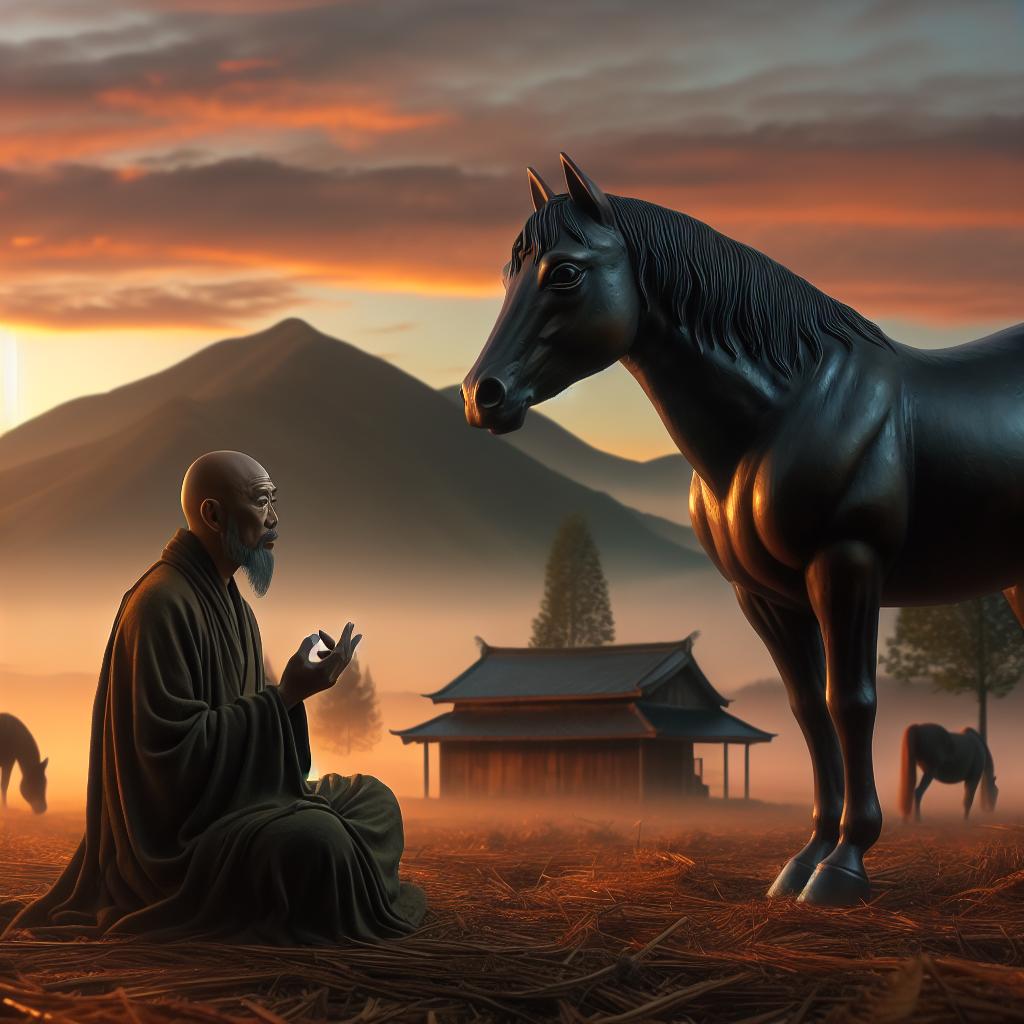
3. Analysis of eastern philosophies in the Parable of the Lost Horse
Title: Galloping Through the Parable of the Lost Horse: An Eastern Philosophy Round-Up
As the sun lazily stretches its limbs over the bustling treetops, I can almost hear distant wind chimes, smell the faint aroma of incense. Somewhere, a guru is pouring himself a steaming cup of enlightenment with a side of vegan, gluten-free scones. Yum! Are you ready to bask in the radiant glow of Eastern philosophy like a lizard on a hot rock? If we lean in close, we might even learn a thing or two.
So let’s saddle up and trot towards the wild mountains of wisdom, examining, or rather, dissecting like philosophical surgeons, an intriguing example of Eastern philosophy embodied in a seemingly innocent story about a farmer, a horse, and the terrains of fate – the Parable of the Lost Horse.
For those unfamiliar with this philosophical powerhouse of a parable, let me give you a quick rundown, quicker than you can say ‘Zen and the Art of Motorcycle Maintenance.’ Our starring farmer loses a horse, which sounds like bad news. But then the horse returns with another wild horse, which seems like good news, right? But then his son breaks his leg while trying to tame the wild horse. That sucks. However, this injury saves the son from being drafted into a destructive war. And the moral of the story? The muscular roller coaster of life, with its ups and downs, holds no absolute good or bad; everything is perpetually in flux.
Firstly, let’s peek through the keyhole of Taoism. Taoism, that ancient master of seeing beauty in the balance, finds its stamp all over this parable. It’s like Taoism wrote the script, auditioned the actors, and even did the catering, serving up plates full of Yin and Yang! The parable reflects Taoist principles of harmony and balance, where something ostensibly negative often contains positive elements and vice versa. When our trusty farmer faced his series of roller coaster-like events, he maintained a zen-like composure that would make even Buddha doff his cap in respect. Lesson Numero Uno: Don’t be too quick to label events as good or bad. Who knows?
Next, we can sense the fragrance of Buddhism in the enduring quality of impermanence exhibited in the parable.
“He studied the philosophies and metaphysics of Greece, and was very strict in religious observances”
~ Unknown, Unknown
This parable has more change than a busker’s hat at a music festival. Everything changes; the horse is lost, then found, the son is wholesome, then broken, peace turns to war. This constant shifting sands of circumstances remind us that nothing in life is permanent, a cornerstone of Buddhist philosophy. We’re all just riding these shifting sands, seeking a decent 4G signal to Google ‘how to achieve nirvana.’
Lastly, let’s swan dive into the calming lagoon of Confucianism. Now you might wonder, Confucianism? Surely you jest! But if you squint your eyes and tilt your head just so, you can see it. Confucian ideals underpin the farmer’s ethical and measured response, emphasizing the importance of wisdom and balanced judgement. Our unflappable farmer, though thrown philosophical curveballs, continues to see his cup of life as half tea, half epic life lessons.
So there you have it, a fun, frolic-filled whistle-stop tour through Eastern philosophies embedded in the parable of the lost horse. We’ve sipped the richly satisfying brew of Taoism, tripped (in the most insightful way) over the pebbles of Buddhism, and scalloped the peaceful waters of Confucianism. Life, my philosophical friends, is like a horse. Sometimes it throws you off and gallops away, but other times it comes back, bringing enlightenment, humor, and a wild horse with it. Remember, there’s always more than one way to interpret the neighs of our lives!
Learn More: 3. Analysis Of Eastern Philosophies In The Parable Of The Lost Horse


